You're Not Having a Midlife Crisis. You're Overdue for an Audit.
"Crisis" implies something broke. What's actually happening is that a version of your life you built at 28 no longer fits the person you are at 45 — and nobody hands you a framework for that. Here's one.
Somewhere in the last year or two, something shifted. Maybe it was a birthday that hit differently. Maybe it was the last kid leaving, or a marriage that quietly stopped feeling like a partnership, or a job you used to be good at that now just feels like noise. You're not falling apart. You're not ungrateful. You're not "going through something" in the vague way people say it when they don't know what else to say. You are, in the most literal sense, outgrowing a structure — and structures don't renovate themselves.
Why "just think positive" doesn't work here
Most midlife content splits into two useless camps: doom ("your best years are behind you") or forced cheer ("you go, girl, reinvent yourself!"). Neither one gives you a framework. Motivation is not a plan. You don't need to feel better about the burnout — you need to know exactly which parts of your life are causing it, because "everything" is not an actionable answer, and treating the whole of your life as broken is how people end up making expensive, dramatic decisions instead of precise ones.
What an audit actually looks like
Before you decide what to release and what to rebuild, you need an honest inventory — not a vague feeling of "something's off," but a specific list of what's actually draining energy versus what's quietly still working. This is the exact starting phase of a real reset, and it looks less like a journal prompt and more like a diagnostic:
"Rate honestly, not aspirationally."
- Which relationships in your life energize you, and which ones do you perform for?
- What does your calendar say your priorities are — and does that match what you'd say out loud?
- What's one commitment you're keeping purely out of guilt, not value?
- If money weren't a factor for one year, what would you stop doing immediately?
Notice none of these questions ask "what's your passion?" — a question so vague it's nearly useless at this stage. They ask for specifics, because specifics are the only thing you can actually act on. This is the difference between reflection and an audit: reflection makes you feel understood. An audit tells you what to do Monday morning.
What comes after the audit
An honest audit almost always surfaces more than it's comfortable to act on all at once. That's fine — the audit's only job is clarity, not immediate transformation. What you do with that clarity (what to deliberately release, and what to rebuild in its place) is a separate, sequential phase. Trying to do all three — audit, release, rebuild — in one weekend of journaling is exactly why most "reinvention" attempts stall by week three.
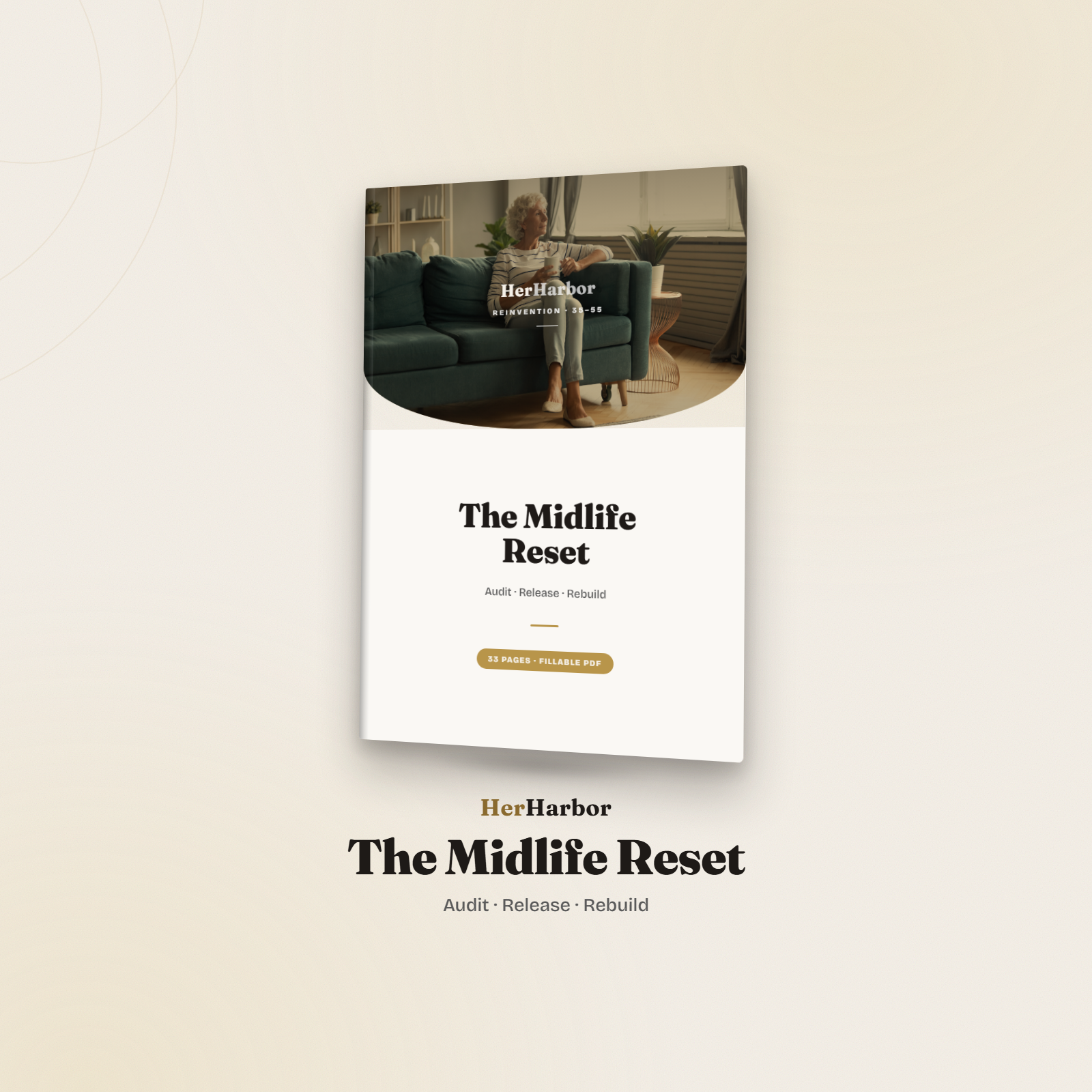
The full framework: The Midlife Reset
A structured 3-phase system — Audit, Release, Rebuild — for women 35-55 navigating burnout, identity shift, or reorganization. 33 pages, $47.
See the full system →Take the free Midlife Clarity Audit
12 direct questions. Rate each one honestly, not aspirationally — this isn't a personality quiz, it's a diagnostic.
Question 1 of 12
Want your full breakdown — which areas to release, which to rebuild — sent to your inbox?
Prefer it right now, no waiting? Get it instantly on Gumroad →
No spam. Unsubscribe anytime. Just real, useful content — no "boss babe" energy.